Walk
Walk is an Android app that supports creative thinking through sound, gentle movement, and minimal distraction.
The design idea
I deliberately avoided making Walk either a fitness app, meditation app, or productivity tracker. Walk has no goals, no metrics, no social features, and no gamification. Unlike any other app on your phone, nothing here is trying to keep you coming back.
The walking screen is plain black to reduce the temptation to glance at your phone. Walk's job is to fade into the background once a walk has started.
The theory
Walk is built on a specific body of research about how creative thinking actually happens:
- Default Mode Network research (Marcus Raichle) — the brain network active during rest and mind-wandering — the kind of unstructured thinking a focused task switches off.
- Focused and diffuse thinking (Barbara Oakley) — insight often needs an unfocused mode to work in, not sustained concentration.
- Unconscious thought theory (Ap Dijksterhuis) — complex problems can be worked on better without conscious attention on them.
- Stanford research on walking and creativity — walking measurably increases creative output compared to sitting, during the walk and shortly after.
- Attention Restoration Theory (Kaplan & Kaplan) — certain environments restore depleted directed attention rather than demanding more of it.
How it works
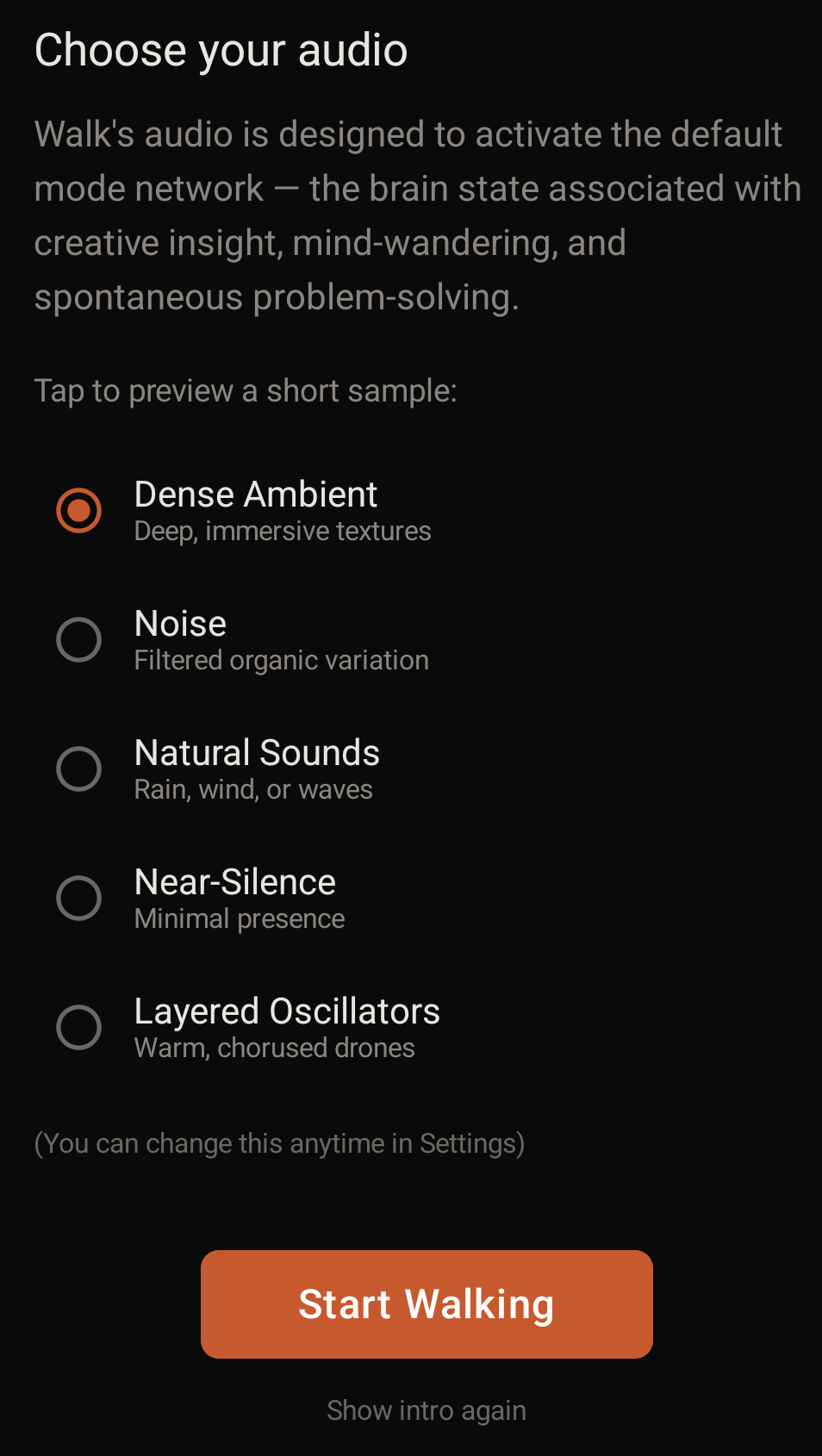
- Five generative audio modules, built on non-looping algorithms that evolve slowly without repetition.
- Single-tap voice memo capture, for catching a thought without breaking stride or fighting an interface.
- A ten-second pre-walk settling period with a sensory prompt, before the walk itself starts.
- The walking screen itself: plain, black, minimal.
Get Walk
Walk is live on Google Play: play.google.com/store/apps/details?id=com.walk.app
Privacy
Walk doesn't collect any data about you — full detail in the privacy policy.